Thursday, November 30, 2017

Thursday, April 6, 2017
Project #2 Surviving the Future


For project 2, I chose to be optimist about the future. I believe (hoping beyond everything) that people are becoming more informed and acknowledging that climate change is real and a serious threat to humanity. However, it’s going to take something extreme to happening for everyone to corporate. Which is why people that recognize climate change and have adapted their lifestyles can come live in my utopia! In my utopia, much of the pollution is still around, but advancements have been made to collect this crap and turn into renewable energy. The population has embraced recycling, in fact nearly everything is reused. Everyone lives in tree houses, or smaller housing. Landfills are a thing of the past, instead the garbage that is created is burned, creating a heat source to disinfect drinkable water. Solar and wind energy is the main source of energy, but much of the population is conserving it for when the sun sets. Family gardens are common, but many humans have come together to feed everyone. Sadly, many people have died, so the population is smaller than what we saw in 2017. Because of this food is a priority. Capitalism has been destroyed and money is not used as a form of currency. Instead, the communities of the world exchange goods such as tools, rare fruits and vegetables, and labor services (slavery is not permitted). Don’t get me wrong humans are humans and sometimes people fight, get angry or just annoyed, but humanity remembers the scars of war and violence, so instead of violence, we rely on the system of courts set up to protect everyone.

Thursday, February 16, 2017
Lecture Paper #2 Exhibition
“DOC/UNDOC” by Felicia Rice with collaboration by Guillermo Gomez Pena, Jennifer Gonzalez, Gustavo Vazquez, and Zachary Watkins.
As
an avid reading, I understand the potential of a book. It has the potential to
change a view point or create a safe space to grow. The Shepard Contemporary
Gallery in Church Fine Arts building has an exhibit feature the concept of the book
called Expanded Reading: The Book to Come curated by Professor Inge Bruggeman
of the art department. The purpose of this exhibit according to the
introduction is to “explore the book as art and the book as a site for artistic
exploration. In particular, for it to offer an expanded reading experience”. Using
a mixture of digital media, the gallery exhibit goes beyond the “mundane chore
of storing and conveying everyday utilitarian information” to draw the audience
into the “book”. There were books stitched into cloth, or a book turned into a
scroll the reader could see as they turned the attached crane. However, the
most striking concept of a book was the “DOC/UNDOC” by Felicia Rice with
collaboration by Guillermo Gomez Pena, Jennifer Gonzalez, Gustavo Vazquez, and
Zachary Watkins.
This
piece was created in 2013. It has been placed on a long table, with the pages
of the booking laid flat. It appears to be able to folded up with the becoming
the cover and back parts of the book. What is most striking about each page is
the colorful picture that draws the audience in, which allows them to discover
that each page also has a passage hidden on the bottom right hand corner. The significant
of this piece that each paragraph tells a small insight into being a Mexican
American. For example, one page talks about the reoccurring trend of national
security since 9/11, saying at one point “I truly wonder who is scarier? The Tijuana
Cartel or the Minutemen? A Chicago gang banger or a Blackwater mercenary?”. This
is the beauty of “DOC/UNDOC”. Upon first glance, you think it’s just pages with
pretty and creative drawings, but in reality it is a political commentary piece
about racism against Hispanics in the U.S. I am drawn to stuff like this
because it’s a subtle, yet passionate attempt to express reason and encourage
empathy. And I also really like the creative ways these artists interpreted the
concept of a book.
Wednesday, February 15, 2017
Project #2 Concept Paragraph and Rough Design
For project two, I’ve decided to be an optimist. I believe
(hoping beyond everything) that people are becoming more informed and
acknowledging that climate change is real and a serious threat to humanity.
However, it’s going to take something extreme to happening for everyone to
corporate. Which is why people that recognize climate change and have adapted
their lifestyles can come live in my utopia! In my utopia, much of the
pollution is still around, but advancements have been made to collect this crap
and turn into renewable energy. The population has embraced recycling, in fact
nearly everything is reused. Everyone lives in tree houses, or smaller housing.
Landfills are a thing of the past, instead the garbage that is created is
burned, creating a heat source to disinfect drinkable water. Solar and wind
energy is the main source of energy, but much of the population is conserving
it for when the sun sets. Family gardens are common, but many humans have come
together to feed everyone. Sadly, many people have died, so the population is
smaller then what we saw in 2017. Because of this food is a priority.
Capitalism has been destroyed and money is not used as a form of currency.
Instead, the communities of the world exchange goods such as tools, rare fruits
and vegetables, and labor services (slavery is not permitted). Don’t get me
wrong humans are humans and sometimes people fight, get angry or just annoyed,
but humanity remembers the scars of war and violence, so instead of violence,
we rely on the system of courts set up to protect everyone.
Adventure Time theme

Rough sketch of box layout

Sweet tree house

350 Project 2 Readings Paper
Its difficult to imagine living a life like the humans in "The Machine Stops" or continuing down our wasteful way until we destroy the planet. Each of the readings has a grim beginning but for project two I would like to stay positive. The two articles at the end do have a hopeful note.
E.M. Forster’s “The Machine Stops” is an insane journey through a future filled with little human inaction, laziness and unhealthy worshiping of the Machine. In the introduction paragraph Paul Rajlich calls this piece “a chilling, short story masterpiece about the role of technology in our lives”. It's difficult for me to believe that this story was written in 1909. However, this shows the caution by humans regarding massive technology use. While reading this story I pictured the movie “Wall-E” from Pixar. In that movie the humans are fat, muscle-less blobs that do nothing. Unfortunately, this story still have relevance today because much of society is addicted to technology. Leading to a generation that is extremely reliant on it. The last couple paragraphs of the story is especially chilling. I can’t imagine not being able to function without technology like the humans featured. The idea that people died because of this is especially sobering. Such reliance on the Machine and the Book combined with the isolation everyone experiences is a great reminder of the harm technology can create.
E.M. Forster’s “The Machine Stops” is an insane journey through a future filled with little human inaction, laziness and unhealthy worshiping of the Machine. In the introduction paragraph Paul Rajlich calls this piece “a chilling, short story masterpiece about the role of technology in our lives”. It's difficult for me to believe that this story was written in 1909. However, this shows the caution by humans regarding massive technology use. While reading this story I pictured the movie “Wall-E” from Pixar. In that movie the humans are fat, muscle-less blobs that do nothing. Unfortunately, this story still have relevance today because much of society is addicted to technology. Leading to a generation that is extremely reliant on it. The last couple paragraphs of the story is especially chilling. I can’t imagine not being able to function without technology like the humans featured. The idea that people died because of this is especially sobering. Such reliance on the Machine and the Book combined with the isolation everyone experiences is a great reminder of the harm technology can create.
The Mother Jones article “50 Years from Now, What Will the World be Like” by Chip Ward is a sincere letter to the author’s grandchildren. He expresses his grief in the fact that his generation is knowingly destroying the planet, and it make my furious. For starter, that fact that we have respected scientist telling the population that we need to change our habits and no one in the older generations cares make me want to scream. However, what the author has to apologize for show a great insight to the mindset of the baby boomers and their children. For example, in the letter Ward states “We got hooked on faster-bigger-more and charged right over the carrying capacity of the planet” (page 2) and “It was handed down to us by our parents' generation so hammered by cataclysmic world wars and economic hardship that they armed themselves to the teeth and saw enemies everywhere. Their paranoia was understandable, but they passed their fears on to us and we should have seen through them” (page 3). This insight into the paranoia of a generation that lived in war and poverty shows their desire to want what Ward called “faster-bigger-more”. Baby boomers and their children are not the only ones that need to see beyond what's in front of them, Ward also reminds his grandchildren about the “industry of silly distractions” that we have become so accustom too.
Ward ends his letter with comforting words, “a better world is possible… Our salvation is found in each other, together” (page 6). It is these words that I want to use for my project, I hope that the generation I belong to will see beyond the “distractions” to insure a better, safer earth.
The final article dives into the psyche of the American people and how they interact with climate change. Author Naomi Klein discusses how we know we are causing harm, but we “are doubling down on the stuff that is causing the crisis in the first place” (page 3). It is interesting how Klein understands our relationship with climate change, stating “maybe we do look – really look – but then, inevitably, we seem to forget. Remember and then forget again. Climate change is like that; it’s hard to keep it in your head for very long. We engage in this odd form of on-again-off-again ecological amnesia for perfectly rational reasons. We deny because we fear that letting in the full reality of this crisis will change everything. And we are right” (page 3). Klein understands that climate change is not constantly on everyone’s mind, instead we get reminders throughout the day. Sadly, we have politician and corporations that affect policies about climate change, on top of the fact that much of the public is misled by these same agencies are keeping us from real life altering change.
Many people that have accepted climate change have come to the same consensus as Klein when she quoted climatologist Lonnie G Thompson about the threat, Klein states “It doesn’t get much clearer than that. And yet rather than responding with alarm and doing everything in our power to change course, large parts of humanity are, quite consciously, continuing down the same road” (page 10). This is extremely frustrating for me. I do not want to live in a “Water World”-like place, and I certainly do not what to rely on machines and computers to survive underground. Something must be done to stop the lack of interest and change taking place.
Thursday, February 9, 2017
Lecture Paper #1 Becoming a Missing Comfort Women Jessica Nakamura
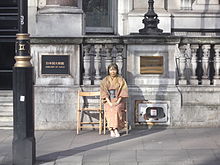
Becoming a Missing Comfort Women
Yoshiko Shimada’s Performances of History in Contemporary Japan
By Jessica Nakamura
Jessica Nakamura’s lecture was about exploring the image of the comfort women during World War two. Comfort women were essentially forced prostitutes from Asian countries concurred by the Japanese army. It is estimated that one hundred to two hundred thousand women from the countries of Korea, China, Vietnam, and even Japan were forced to sexually serve an average of 20 to 60 men a day. The army saw these women as supplies for the men, but conditions were often horrible. Many women were as young as 15 years old when taking and were often left behind or killed when the army retreated. Today, Japan sees this history as a stain on their image, even going to great lengths to destroy evidence and documentation. According to Ms. Nakamura, there is a taboo that follows women who identify or say they were used as comfort women. However, in 1991 former comfort women took their fight to the court systems in Japan. As of 2015, there was some recognition on the Japanese government but they can with stipulations many people were hesitated to agree too.
Ms. Nakamura focuses are Yoshiko Shimada’s “Becoming a Statue of a Japanese Comfort Woman” 2012. Shimada started her work during the early 1990s, when the comfort women went to court, because many Japanese people were unaware of this dark history. This piece, performed in London outside the Japanese Embassy as a reaction the government denial to recognize them. Nakamure argues that Shimada’s piece demands the audience (people walking by) engage with her physical form, creating a relationship. Because youth of Japan isn’t aware of the role of comfort women in WW2, Shimada intents to stop the brainwashing and force them to recognize and interact with the symbolism of Japanese violence and aggression towards women.

Nakamura also discussed the Bronze statue in Seoul Korea (also outside the Japanese Embassy). The piece is an image of a woman sitting with her feet and hand placed flat. Nakamure argues that the statue explores the idea of female sexuality, meaning the audience calls the statue “grandmother” essentially erasing her sexuality, which in turn, diminishes the horrible conditions these women went through.
Overall, the lecture was a reminder to the younger generations about the horrors of war and the violence it inflicts on people. Sadly, many comfort women have not come forward and those who have, many not live long enough to see any compensation from the Japanese government. However, Jessica Nakamura does end on a positive note: Yoshiko Shimada’s piece and other comfort women statues around the world will continue to stand and serve as a reminder of injustices and violence towards women.
Monday, February 6, 2017
350 Project #1: Assemblage
Waste Tree
Waste Tree is the product of wasted food growing into a crazy mess of plastic bowls, old cell phones, and two flags. The stem is made of measuring cups, and slight at the fact very few people take the time to measure or think about how much they consume. My original goal was to use a measuring cup and have green trees and plants growing from it. A piece meant to inspire people to be thoughtful about what they use and/or waste. I had trouble finding trees that would upload, so I went slightly more dark in my message.


Tuesday, January 31, 2017
Art 350 Reading Discussion Questions
1. How can we reduce the waste we have when it comes to food? Can we change now, or is it too late?
2. In the US, we have this mentality that if you work hard, we will get out of poverty. But is that a real expectation for the poor when so much is against them.
2. In the US, we have this mentality that if you work hard, we will get out of poverty. But is that a real expectation for the poor when so much is against them.
Saturday, January 28, 2017
Artist Statement for Art 350
My Artist Statement

Barbara Kruger
For my artist statement, I would like to focus on learning to develop my techniques with the projects we use in Art 343 and Art 350. My projects will be based on my personality, my interests and possibly my beliefs. My main focus with be to understand systems like Maya, Adobe Photoshop and other Adobe systems. I think the ability to create is my favorite part of art.
I enjoy contemporary art. I also identify with feminism based art work. I think I will be influenced by the politic atmosphere I see today.
Subscribe to:
Comments (Atom)